


Inventory replenishment has become a bigger priority than ever. Demand is unpredictable, lead times are longer, capacity is tight, and service expectations keep rising. It’s no surprise that inventory imbalance is a big problem for supply chains, and most of that imbalance traces back to poor replenishment decisions.
Research shows that stock reallocation and replenishment can account for 30–40% of transportation costs, which means every order decision matters.
Yet many companies still rely on simple reorder point rules that break under real-world complexity and create hidden costs. End-to-end replenishment optimization changes this by using data and network-wide insights to decide what to order, when to order, and how much creating a smarter, more flexible supply chain replenishment strategy.
Stop Reordering Blindly: What Replenishment Optimization Really Means
Replenishment is no longer just “When do we reorder?” but “How does the entire system replenish end to end?”
In the traditional view, you set a reorder point, held some safety stock, and ordered a fixed quantity when levels dropped. This worked when demand was stable. Today, demand shifts quickly, lead times change week to week, suppliers face limits, and transportation choices heavily impact cost and service. One simple rule can’t manage all this.
Modern demand-driven replenishment optimization looks across the whole network multi-echelon flows, sourcing limits, storage constraints, and transport modes. Instead of isolated triggers, it uses intelligence to decide what to replenish, where, when, and how, while balancing cost and service.
Core Goals of Replenishment Optimization
The goal is simple: reach the best trade-off between service, cost, and resilience.
A strong supply chain replenishment optimization model balances:
- The right inventory levels for the desired service rate
- Freight and transportation costs across modes and lanes
- Sourcing or manufacturing limits
- Overall network stability and resilience
Why Getting Replenishment Wrong Is So Expensive
Poor replenishment doesn’t just hurt service, it drags down your entire cost structure. Mistakes add up fast. For example, a tangled or outdated data set, inconsistent SKUs, wrong lead-time info, or missing supplier data will produce flawed automatic replenishment triggers. That alone can cause stockouts, over-orders, or items shipped to the wrong place.
Relying on manual processes or ignoring automation fuels more problems. Human error, fear of under-stocking, and guesswork tend to push companies toward overstocking. That adds holding costs, ties up capital, and inflates warehouse expenses.
Warehouse and data-visibility failures amplify the pain. If your stock counts are wrong, or you lack real-time insight into inventory across sites, even the best-meaning replenishment logic fails. That leads to unnecessary orders, excess freight, overstock or stockouts eroding both margins and service.
Bad replenishment also distorts responsiveness: inaccurate demand forecasts or ignoring seasonality means you’ll either understock fast-movers or overstock slow ones. Both cases kill efficiency.
With logistics networks becoming more adaptive and dynamic by the day, rigid replenishment rules just don’t hold up.
Traditional vs. Demand-Driven Replenishment Plans
While traditional approaches offer structure, they struggle in today’s volatile environment and often create hidden costs across the network.
Aspect |
Traditional Replenishment |
Demand-Driven Replenishment |
| Decision Trigger | Fixed reorder points and static thresholds | Real-time demand signals, lead-time shifts, and network conditions |
| Order Quantity | Pre-set, often fixed quantities | Dynamic quantities based on actual demand and constraints |
| Frequency of Orders | Regular but rigid cycles | Flexible and adjusts to demand changes |
| Visibility | Limited to single node or SKU | Network-wide visibility across all echelons |
| Responsiveness | Slow to react to volatility | Fast adaptation to demand swings and supply disruptions |
| Data Used | Historical averages with simple rules | Real-time data, forecasts, constraints, and multi-node interactions |
| Handling of Constraints | Usually ignores supplier, capacity, or transportation constraints | Optimizes around sourcing limits, warehouse capacity, and transport modes |
| Service Impact | Higher risk of stockouts or excess inventory | Balanced service levels with optimized inventory placement |
| Cost Impact | Frequent hidden costs (expedites, overstock, wasted transport) | Lower transportation waste, better mode selection, fewer surprises |
| Network Alignment | Works in isolated silos | Aligned across the entire supply chain network |
Single-Echelon vs. Multi-Echelon Replenishment Optimization
In a single-echelon setup, you optimize each node on its own.
A DC, a plant, or a store looks only at its own demand, its own safety stock, and its own reorder rules. The goal is simple: keep that one location in a “good” inventory range.
This works in simple networks. For example, a single DC serving one market, or a small number of stores with short, reliable lead times. In those cases, local rules can be enough.
But it fails when the network gets more complex. If a central DC feeds several regional DCs and hundreds of stores, optimizing each point in isolation leads to:
- Too much stock in some locations and too little in others
- Duplicate safety stock at every level
- Unplanned transfers and emergency shipments to “fix” gaps
Single-echelon logic can’t see how one node’s decision affects the rest of the network.
In a multi-tier inventory replenishment setup, you:
- Use central buffers (like a main DC) to protect many downstream locations
- Decide when to replenish each level and how much to send, considering the full network
- Optimize not just inventory levels, but also transfers between locations, lead times, and transportation modes
This is network-wide replenishment optimization: timing, quantity, and movement decisions are made with the whole system in mind, not just one node.
Benefits of a Multi-Echelon Approach
Done well, multi-echelon replenishment optimization delivers clear gains:
- Lower total inventory across the network while keeping the same or higher service levels
- Less bullwhip effect, because upstream nodes see a smoother, more accurate view of true demand
- More stable plans, with fewer last-minute expedites and fire-fighting transfers
- Smarter use of central buffers, so a single pool of stock protects many locations instead of overstocking each one
In short, you stop optimizing “everywhere individually” and start optimizing the whole network as one system.
Linking Replenishment to Supply, Production, and Transport Constraints
Replenishment decisions don’t happen in a vacuum. Every order you place must respect the realities of supply, production, and logistics. This is where constrained replenishment optimization becomes essential.
Supplier and Production Constraints
Suppliers often operate with limited capacity, variable lead times, and inconsistent reliability. A replenishment plan may call for 500 units next week, but if the supplier can only produce 300 or ships late, your downstream targets collapse instantly.
Production adds another layer of complexity. Plants work with fixed batch sizes, cycle times, changeover costs, and capacity allocations. Even if a location “needs” a certain quantity, the production schedule might not align. You can’t replenish in quantities the production line physically cannot make.
Transport and Logistics Constraints
Transportation places its own limits on replenishment timing and quantity.
Full truckload (FTL) is cheaper per unit but requires larger volumes; less-than-truckload (LTL) is flexible but more expensive. Decisions must also consider route options, consolidation windows, cross-dock timing, and carrier availability.
This is where transportation-aware replenishment matters: ordering too little wastes capacity, while ordering too much inflates freight costs or overwhelms the DC.
How Constraints Shape Inventory Replenishment Plans?
In theory, a replenishment model might suggest a “perfectly optimal” quantity or frequency.
In reality, that ideal number often clashes with hard constraints:
- Supplier can’t make it
- Production line doesn’t have capacity
- FTL minimum volume isn’t met
- Consolidation window is missed
- Cross-dock schedule doesn’t align
This is why capacity-aware replenishment planning is so important. The optimization engine must embed real-world constraints on supplier capacity, production schedules, transport modes, and consolidation limits, so the plan isn’t just mathematically optimal, but operationally executable.
When replenishment decisions truly reflect the constraints of supply, production, and logistics, the supply chain moves from planning on paper to planning that works in the real world.
How Sophus Powers End-to-End Replenishment Optimization
Unified Network Design and Replenishment Engine
Sophus brings network design and replenishment together in one unified engine. Instead of treating replenishment as a separate activity, Sophus first models the entire supply chain network plants, hubs, DCs, stores, capacities, transportation modes, sourcing paths, and cost structures.
The outputs of network design optimized flows, lane capacities, inventory placement, and service targets automatically become inputs for replenishment planning. This ensures replenishment decisions are grounded in how the network actually works, not in static rules or isolated calculations.
Multi-Echelon Replenishment Optimization in Sophus
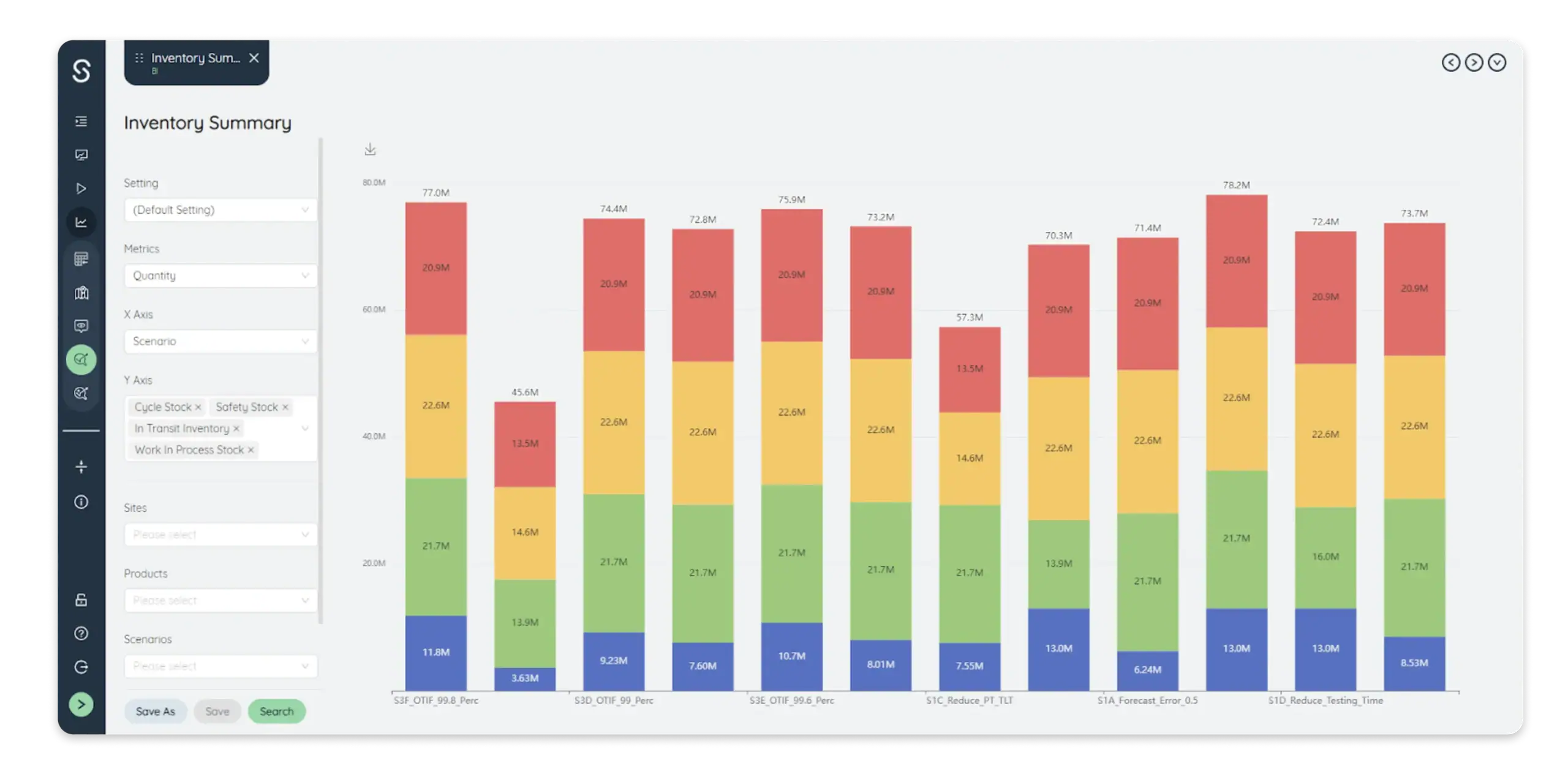
Sophus applies true multi-echelon replenishment optimization across every tier of the network: plants, central hubs, regional DCs, and stores. It sets optimized inventory targets at each level, then determines when to replenish, how much to send, and which mode to use, based on full end-to-end constraints.
Once inventory levels are set, Sophus incorporates all business rules and operational realities, supplier capacity, sourcing strategy, production schedules, transportation limits, consolidation windows, and cost–service trade-offs. These inputs flow into one optimization engine that generates replenishment decisions that are both optimal and executable.
Recently, Sophus helped a pharmaceutical company struggling with rising inventory levels and inconsistent planning across raw materials, intermediates, APIs, and finished goods. Using an end-to-end inventory model that captured real testing cycles, batch times, transport lead times, and service targets, Sophus identified where safety stocks were overly conservative and where inventory could be safely reduced.
Through scenario planning and multi-echelon optimization, the company brought its inventory back to balance unlocking millions in savings while maintaining strong OTIF performance.
AI-Driven Parameter Tuning and Scenario Planning
Sophus automatically tunes key replenishment parameters such as safety stock, reorder points, order quantities, and cycle times. Instead of relying on outdated rules, its AI adjusts parameters using actual demand variability, lead-time patterns, and cost structures.
Scenario planning is built in. You can simulate the impact of a new supplier, a lead-time change, a DC closure, or a new channel, and Sophus instantly recalculates replenishment flows across the network. This gives organizations a practical way to test decisions before they commit, strengthening resilience and long-term planning.
Final Words: Inventory Replenishment That Matches Today’s Complexity
Rising demand uncertainty, shifting lead times, and complex multi-tier networks make replenishment far too important to leave to static rules and isolated decisions.
End-to-end replenishment optimization changes that. By combining multi-echelon thinking, real constraints from supply, production, and transportation, and AI-driven intelligence, companies gain a replenishment strategy that is fast, adaptive, and built for real-world complexity.
Sophus takes this even further by unifying network design and replenishment into one integrated engine—so every order, every transfer, and every flow aligns with the way your network is truly meant to operate.
If you’re ready to move beyond static rules and build a smarter, more resilient replenishment strategy, book a live demo with Sophus. Or start small: run a focused pilot on a single region or product line and see the impact for yourself.