


Between 2020 and 2024, this pharmaceutical giant’s overall inventory doubled from about 100 Days of Supply (DOS) to more than 200. What began as a pandemic-era measure to protect service levels and hedge against uncertainty gradually turned into a continuing burden on working capital and the company’s bottom line.
Finance and management teams repeatedly questioned why so much inventory was needed. The planning organization, meanwhile, struggled to provide a consistent, data-driven answer.
Behind the issue lay a familiar set of challenges:
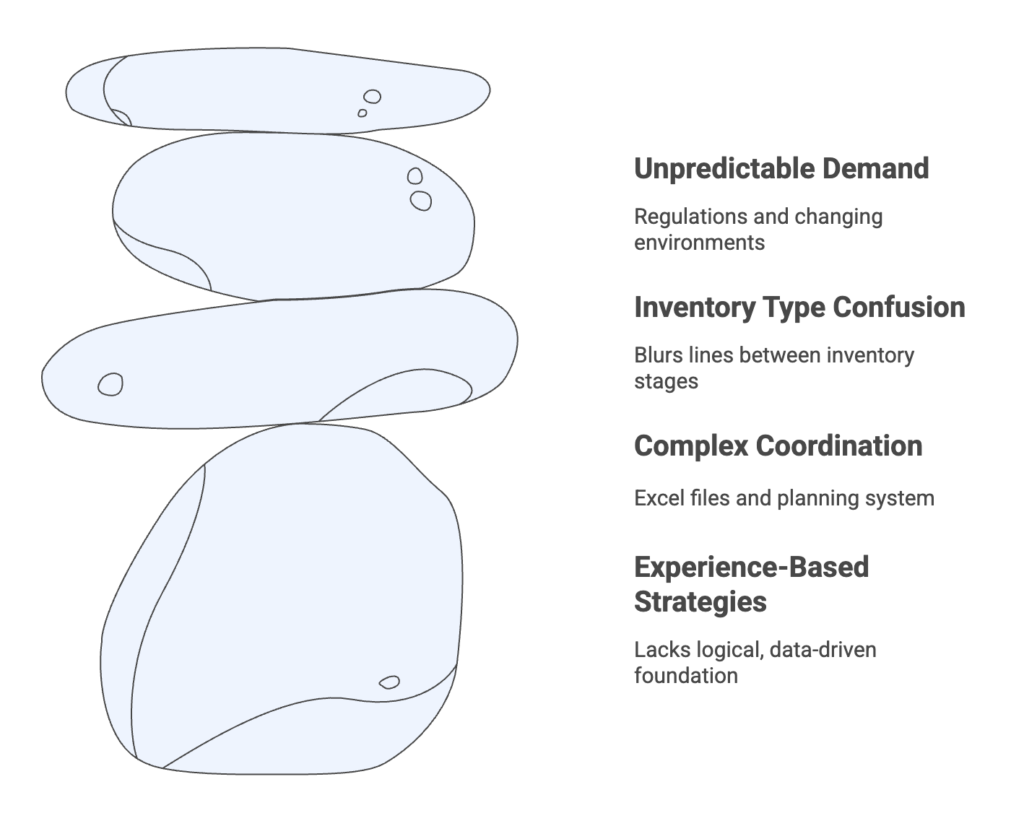
- Inventory strategies were built on experience rather than logic.
- Dozens of Excel files, combined with a heavy supply chain planning system, were used to coordinate between departments.
- The differences between finished goods, semi-finished goods, and API inventory were unclear and difficult to balance.
- Strict pharmaceutical regulations, complex testing procedures, and changing political and policy environments made demand less predictable.
In short, the company was operating with a competent team but without a unified data model and method to understand why inventory levels behaved the way they did.
The Objectives
The goal was not simply to “reduce inventory.” In a pharmaceutical supply chain, safety stock plays a critical role in ensuring compliance, patient safety, and service reliability.
The real challenge was to determine what drives inventory at each stage of the value chain and to identify where AI and optimization could safely reduce excess without increasing risk.
Key questions guided the initiative:
- Which factors — such as testing cycle time, transportation time, or target service levels — had the greatest impact on inventory?
- How should inventory be balanced between APIs, intermediates, and finished goods?
- How can planners evaluate different “what-if” scenarios quickly, without weeks of calculations?
The Solution: Building a Transparent, End-to-End Model
The pharmaceutical giant partnered with Sophus to move from weeks-long manual coordination toward an AI-driven inventory optimization framework.
The first step was to systematically connect all existing rules and assumptions behind inventory decisions into the Sophus inventory data model. Each factor — testing time, release cycle, production batch size, service level target, and transportation lead time — was quantified and connected, allowing AI and optimization to analyze and determine its impact on stock levels.
With this foundation, an end-to-end inventory model was developed, encompassing the entire supply chain from raw materials to intermediates to finished goods.
The model enabled planners and management to run what-if analyses dynamically:

- What is the No. 1 factor driving inventory up?
- What is the bottleneck process that, if optimized, can bring the most value to the business?
- What if testing time is reduced by 10%?
- What if the transportation lead time is shortened?
- What if service levels are adjusted for certain product categories?
These scenarios could now be tested instantly, with visibility into how each change would affect inventory, service levels, and cash flow.
Instead of debating spreadsheets, the teams were now aligned around a single version of truth an AI-based analytical model that could explain, predict, and optimize.
From Model to Practice
As the model was calibrated with the company’s operational data, several insights quickly emerged:
- Certain semi-finished products had overly conservative safety stock policies.
- APIs carried longer-than-necessary buffers due to legacy testing cycle assumptions.
- Finished goods inventories were being held at higher levels than justified by actual demand variability.
Each insight represented an actionable opportunity to rebalance stock and release cash tied up in inventory — while maintaining or even improving service levels.
The inventory model became a practical decision-support tool, not a one-time exercise. It was integrated into the planning process and updated every week. Planners could now test new policies, evaluate supply risks, and refresh their parameters with real data — creating a continuous improvement loop.
Results and Impact
The results were both quantitative and organizational:
Tens of Millions of reduction in working capital
The model identified opportunities to reduce inventory by tens of millions in value, primarily through more accurate allocation across finished goods, intermediates, and APIs.
Clear visibility into drivers of inventory
The team gained a transparent view of what factors influenced inventory levels the most, allowing discussions with finance and management to move from “why” to “how much and where.”
Standardized rules and logic
By replacing experience-based planning with model-based logic, inventory parameters became consistent across plants and product lines.
Continuous optimization process
A weekly model refresh and what-if mechanism were established, enabling planners to continuously test and fine-tune their assumptions in response to real market changes.
As the planning manager summarized:
“Before, we managed inventory by legacy habit. Now, we manage it with facts.”
Lessons Learned
The most valuable outcome of this project was not only the inventory reduction itself but the clarity it brought to decision-making.
The process revealed that optimization in a pharmaceutical environment is less about aggressive cost-cutting and more about creating a shared understanding of the system’s logic. When each parameter — from testing time to lead time to service target — can be visualized and quantified, inventory decisions become faster, more confident, and easier to justify across functions.
Finance teams gained visibility into the rationale behind inventory; operations gained flexibility to adjust policies quickly; and planners gained a structured way to challenge old assumptions.
The company’s experience shows that inventory optimization is not a one-time project but a continuous capability. The weekly AI and optimization model now acts as a decision engine — running silently in the background, helping the company stay agile in a market shaped by constant changes in regulation, procurement policy, and demand behavior.
By integrating optimization into the core of its planning process, this pharmaceutical giant has turned inventory from a reactive problem into a managed, measurable lever for business performance.