


The core business challenge was a lack of granular, defensible insight into the Total Landed Cost (TLC) per shipment, broken down by customer region and product category (e.g., small envelope versus large bulky item).
Without this insight, the commercial team could not accurately price tenders, and management could not pinpoint which customer segments were truly profitable once the full allocation of fixed and variable supply chain costs was factored in.
The company required a model that could accurately attribute both the significant fixed operating costs (e.g., sortation facility leases, permanent staff) and variable costs (fuel, last-mile driver labour) to every single parcel flow.
The Solution: An End-to-End Cost-to-Serve Digital Twin
The client partnered with Sophus to construct an end-to-end supply chain network digital twin using the Sophus X platform. This required a high level of detail to capture every step of the parcel journey:
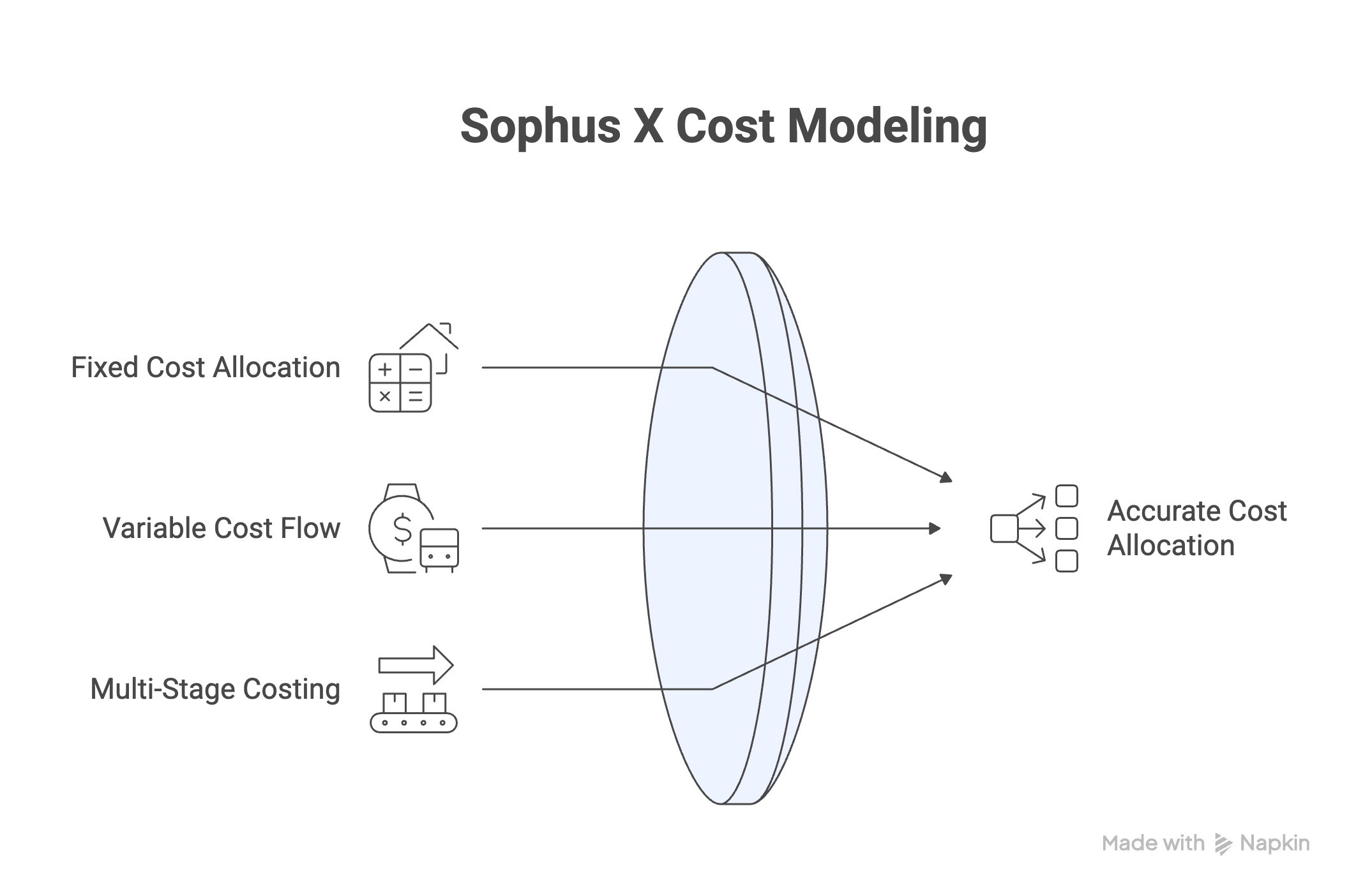
- Fixed Cost Allocation: Sophus X modelled the full fixed cost structure of the sortation hubs and regional distribution centres. Using volume throughput as the driver, the model systematically allocated these overhead costs down to the individual customer region and product type.
- Variable Cost Flow: The model integrated real-time variable data, including Vehicle Route Optimisation (VRO) outputs for last-mile delivery. This allowed for precise measurement of variable costs, such as the exact time and distance consumed by each parcel during the collection and last-mile stages.
- Multi-Stage Costing: The network was mapped across all five stages, ensuring that costs accumulated accurately. For example, the cost of a parcel passing through an automated sortation centre was calculated based on its dimensional weight and the specific handling required, differentiating it from the pure transport cost of the middle-mile linehaul.
Key Insights and Outcomes
The resulting analysis delivered unparalleled clarity, transforming the company’s pricing and operational strategy:
True Profitability by Region
The TLC analysis definitively exposed unprofitable regions and customer segments. The model demonstrated that the high cost of servicing low-density rural last-mile delivery zones due to greater travel distance and time far outweighed the revenue generated from certain low-volume customers in those areas. This allowed the company to renegotiate contracts or strategically adjust pricing in those high-cost lanes.
Product-Specific Costing
By accurately allocating sortation and handling fixed costs, the company discovered that large, non-conveyable items were disproportionately consuming labour and space resources. The new cost framework enabled the introduction of tiered pricing based on the true cost of handling within the sortation process, rather than generic weight/size brackets.
Strategic Investment Framework
The analysis provided a powerful tool for strategic decision-making. By understanding the cost impact of current infrastructure, the company could rapidly simulate ‘what-if’ scenarios, such as the optimal location for a new regional sortation hub or the financial justification for investing in automated sorting equipment to reduce the variable handling cost of specific product types.
The comprehensive cost-to-serve analysis transformed the Parcel Delivery company from reacting to market rates to proactively setting profitable rates based on their true, granular cost drivers across the entire end-to-end supply chain.