

In the world of global manufacturing, cost optimization often dominates the supply chain conversation. Yet for companies operating at scale and across continents, the true challenge lies not just in cutting costs — but in balancing cost, compliance, and resilience in a rapidly changing geopolitical and regulatory landscape.
That’s the realization that came to one of the world’s largest manufacturers of solar energy products and precision energy components.
For years, the company’s European network ran like clockwork. Shipments from Asia arrived primarily through Rotterdam and Antwerp, two of Europe’s busiest and most sophisticated ports. From there, goods were distributed to national distribution centers (DCs) across key markets — Germany, France, Spain, Italy, and the Nordics.
But as the company’s European business expanded, so did the complexity of its logistics environment and the geopolitical landscape. Shipping volumes had grown sharply. Energy policies across the EU were shifting toward stricter sustainability standards. And, perhaps most critically, like the US, the EU tariff and customs regimes were evolving in ways that made some long-favored ports less cost-effective than before.
The leadership team soon realized something fundamental:
“Our network still works,” one executive noted, “but it’s working harder than it should — and not necessarily smarter.”
The Challenge: When Cost Isn’t the Whole Picture
Like many manufacturers, the company’s initial focus was on logistics cost per unit. The assumption had been simple: choose the most efficient port and the lowest-cost lanes, and the rest would follow.
But in practice, the numbers told a different story.
While Rotterdam and Antwerp offered world-class infrastructure and connectivity, they also came with higher handling costs, port congestion, and, in some cases, longer customs lead times due to complex import classifications for high-tech energy equipment.
Moreover, because the company’s product portfolio included components subject to specific tariff codes and regulatory controls, even small differences in customs treatment or country-specific energy regulations could translate into significant financial impact.
At the same time, the company was exploring new regional assembly and refurbishment centers in Europe. This made the question of where to locate DCs — and how to align them with inbound routes — even more critical.
Poorly placed DCs might add not just transportation costs, but also unwanted tax exposures, cross-border VAT complexity, and sustainability reporting burdens.
In short, the Company was not only optimizing its logistics network but also needed to optimize its trade ecosystem.
The Goal: Smarter, Not Just Cheaper
The company’s European leadership set out a clear strategic objective:
“Reduce total logistics cost by at least 5%, without compromising service, while future-proofing the network against trade and regulatory volatility.”
This required a different kind of optimization — one that didn’t treat tariffs, customs, and regulations as afterthoughts, but as central design variables.
Here is when the company engaged Sophus. Sophus’s approach was to combine end-to-end modeling with intelligent supply chain scenario planning, allowing the company to evaluate not just cost and distance, but trade compliance, customs performance, and sustainability factors across every possible configuration.
The Solution: Integrated Network Design with Sophus
The Sophus platform allowed the company’s team to simulate its entire European inbound and distribution network from a blank slate — testing multiple “what-if” scenarios to explore alternative port and DC combinations.
Key inputs included:
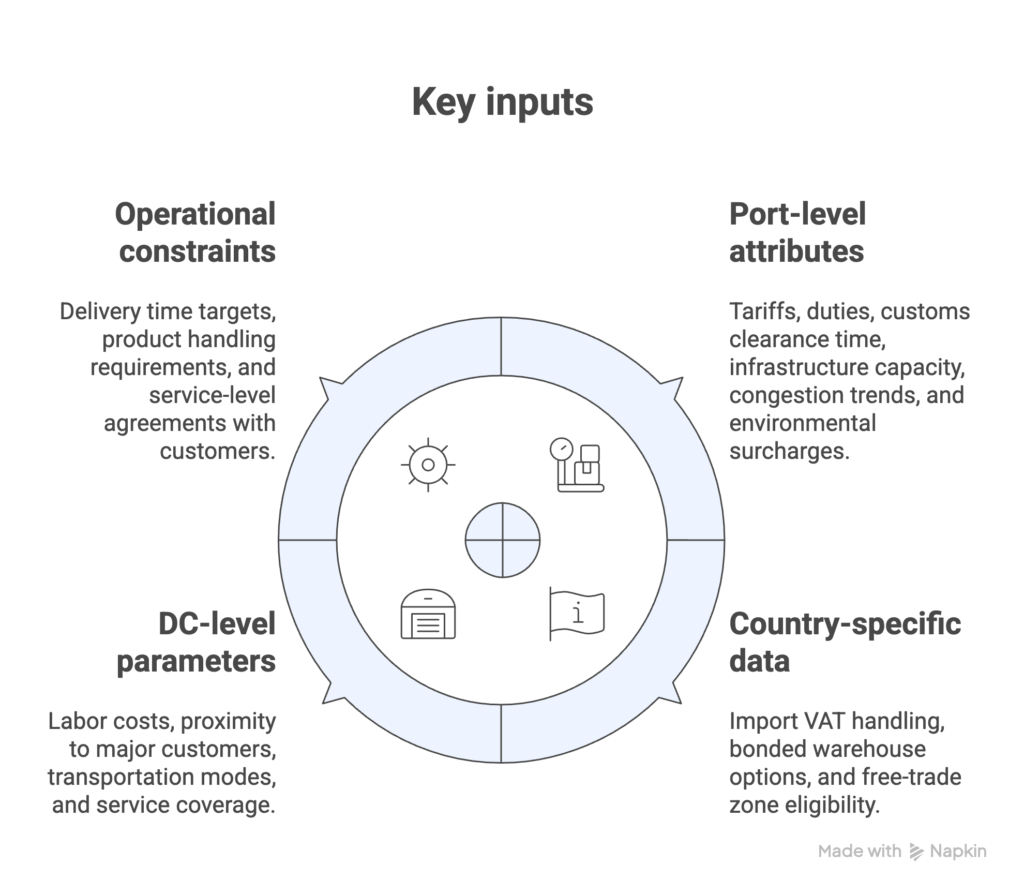
- Port-level attributes — tariffs, duties, customs clearance time, infrastructure capacity, congestion trends, and environmental surcharges.
- Country-specific tax and regulatory data — including import VAT handling, bonded warehouse options, and free-trade zone eligibility.
- DC-level parameters — labor costs, proximity to major customers, transportation modes, and service coverage.
- Operational constraints — delivery time targets, product handling requirements, and service-level agreements with customers.
Unlike traditional logistics cost models, Sophus’s algorithm integrated financial, regulatory, and operational dimensions in a unified optimization framework. The goal was to minimize total landed cost — not just transport expense — while meeting all compliance and service requirements.
In practice, this meant the platform didn’t simply ask, “Which port is cheaper?”
It asked instead:
“Which combination of port and DC minimizes total duty exposure, reduces clearance time, and still meets customer SLAs — today and three years from now?”
The simulation ran across hundreds of possible network configurations, evaluating the trade-offs between cost, compliance, and resilience. It also allowed the company to test how changes in EU trade policy or renewable energy incentives could shift the optimal setup over time.
The Findings: Where Policy Meets Performance
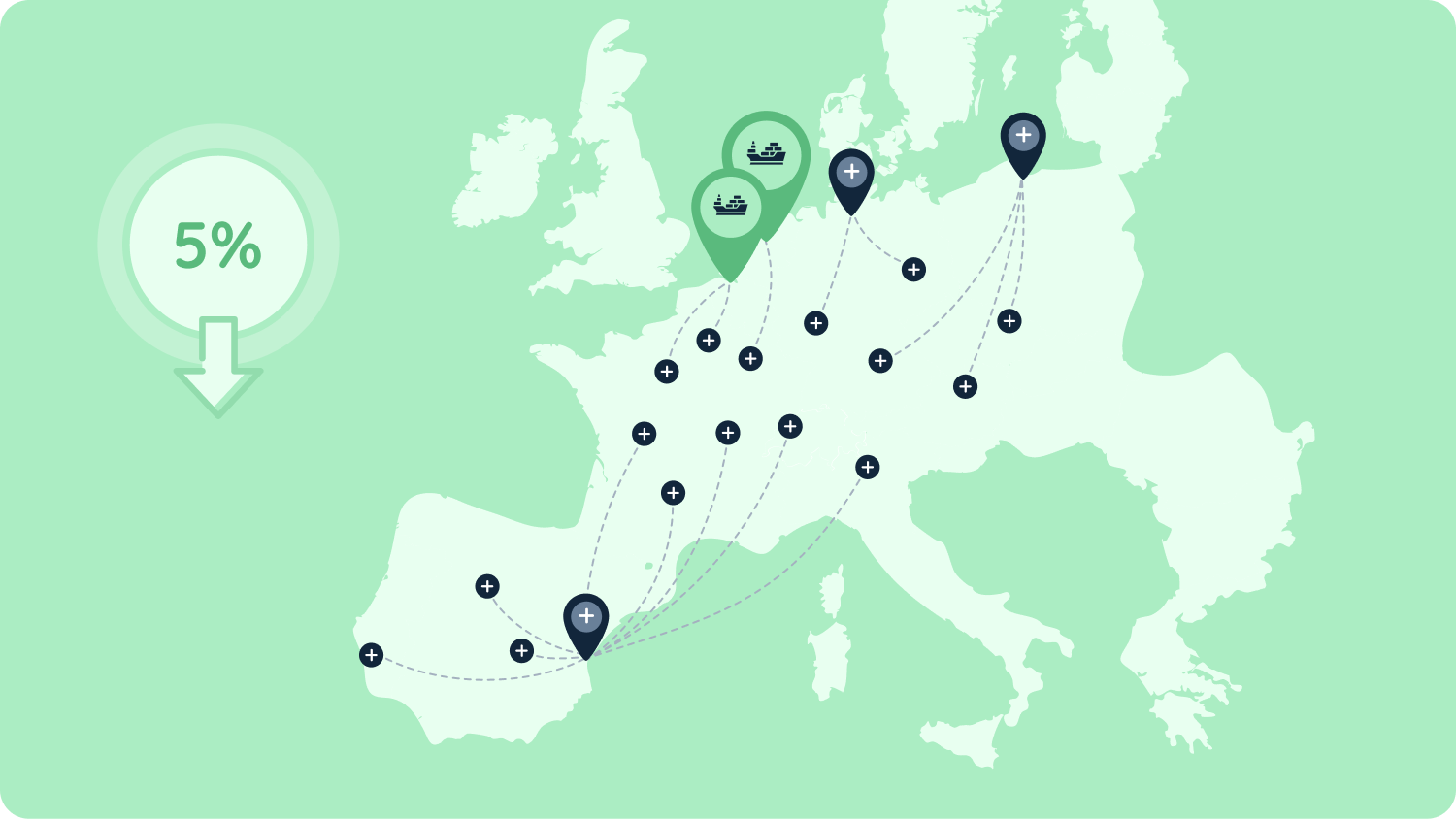
Sophus’s analysis revealed that while Rotterdam and Antwerp remained efficient for certain high-volume lanes, alternative entry points such as Hamburg, Gdańsk, and Valencia offered distinct advantages depending on product category and destination market.
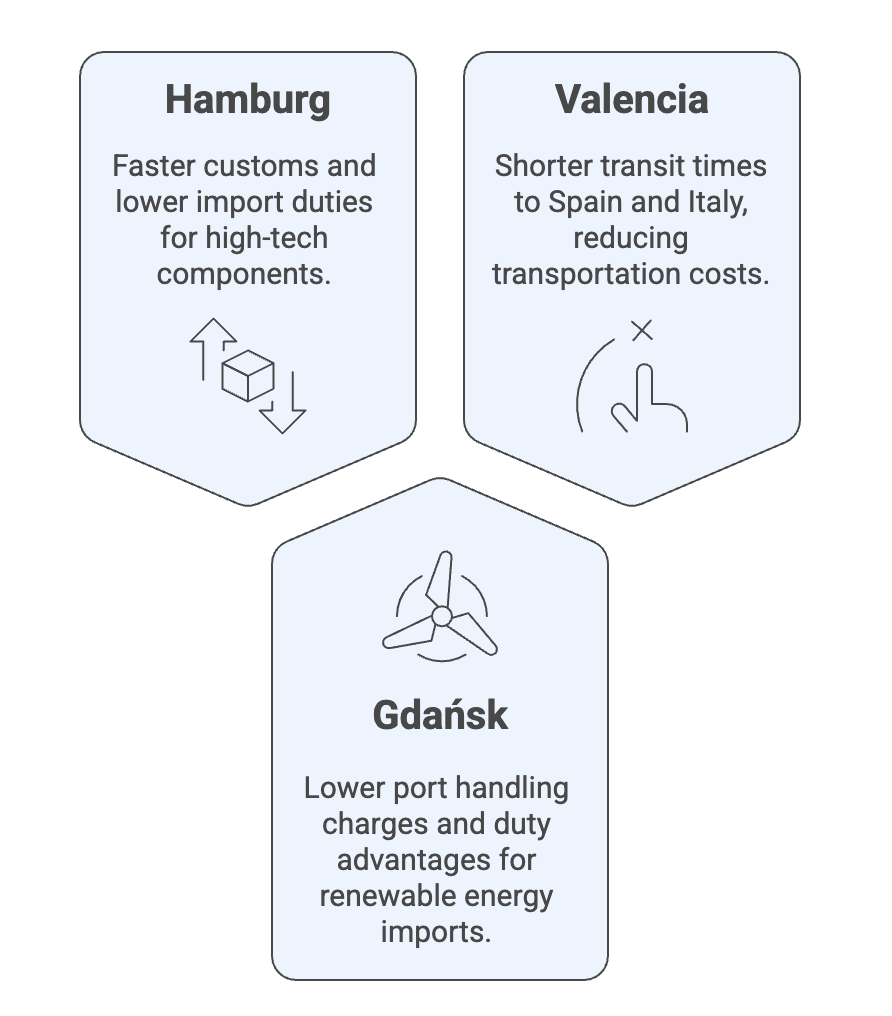
- Hamburg provided faster customs processing and lower import duties for specific high-tech components under German industrial exemptions.
- Gdańsk, though farther for some destinations, offered lower port handling charges and duty advantages under Poland’s renewable energy import framework.
- Valencia presented opportunities for southern European markets, offering shorter transit times to Spain and Italy, which cut downstream transportation costs by up to 12%.
These discoveries reshaped the conversation. What started as a search for cheaper freight evolved into a strategic reconfiguration of how the company’s products entered and moved through the European market.
The Results: A Network Designed for the Future
By integrating all cost and regulatory factors, the company’s team identified a 5% reduction in total logistics cost across its European network. But equally important, they gained:
- Faster and more predictable customs clearance through diversified ports.
- Reduced tariff exposure by aligning inbound flows with the most favorable regulatory environments.
- Optimized DC placement, improving service levels and lowering regional last-mile costs.
A clear, data-driven implementation roadmap for rolling out the redesigned network without disrupting operations.
Beyond the quantitative gains, the project gave the company something even more valuable — strategic visibility. The company now had a digital model it could continuously update, enabling proactive decision-making as trade rules, demand, and sustainability targets evolve.
The New Frontier of Supply Chain Optimization
For the company, this initiative underscored a new reality in global supply chain management:
Optimization is no longer a matter of trucks and warehouses — it’s about trade intelligence.
In a world where tariffs shift overnight and sustainability rules tighten each year, the competitive advantage lies in networks that are not only efficient but also adaptive and compliant by design.
As one company executive summarized:
“We used to see logistics as the tail end of production. Now, it’s part financial, part operational, part geopolitical.”