



Can Your Supply Network Planning Still Rely on Spreadsheets or Legacy Planning Software?
Supply network planning do not fail because people are careless, they fail because some supply chain planning mistakes become unavoidable once scale makes manual planning impossible. This was exactly the situation facing a global food and beverage manufacturer operating 63 factories, hundreds of production lines, and millions of product–line–region combinations.
For years, weekly production and shipment planning was built manually through spreadsheets and a legacy planning system. A handful of experienced planners held the network together through intuition, tribal knowledge, and long working hours.
But as the company expanded, this approach broke down. Costs rose, production lines became imbalanced, and planning cycles took too long. Leadership realized the issue was not lack of effort; it was lack of structure.
They came to Sophus with a clear mandate:
“We need a weekly supply network plan that is accurate, repeatable, cost-optimized, and scalable.”
What followed was a complete redesign of the company’s supply network planning logic and decision framework as well as their supply chain survival guide.
The Challenge: Weekly Planning Had Become Unmanageable
The network’s complexity had outgrown the tools used to manage it. Planners had to manually account for:
- 63 factories
- Hundreds of lines with different efficiencies
- Tens of millions of product–line–region combinations
- Seasonal labor and demand fluctuations
- Labor, energy, transportation, and tax costs
- Regional allocation rules
- Line-dependent production behavior
The reality was clear:
No human or spreadsheet could reliably process this level of complexity every week.
The business needed a structured, system-driven way to handle decisions that had previously relied on individual judgment.
What the Business Required to Plan Effectively?
The company defined several non-negotiable requirements for a new planning approach:
- Standardized cost modeling across labor, energy, transport, and taxation
- Accurate and regularly refreshed line capacities
- Automation of weekly production and shipment plans
- Supply chain Optimization that maximizes fulfillment and minimizes cost
- Full enforcement of all operational constraints
In other words, they needed a supply chain network planning engine that could run every week, incorporate real-world cost and capacity changes, and deliver one consistent plan that everyone could trust.
How Sophus Rebuilt the Supply Network Planning Logic
Sophus converted a highly manual, experience-driven process into a structured, system-driven workflow through below steps:
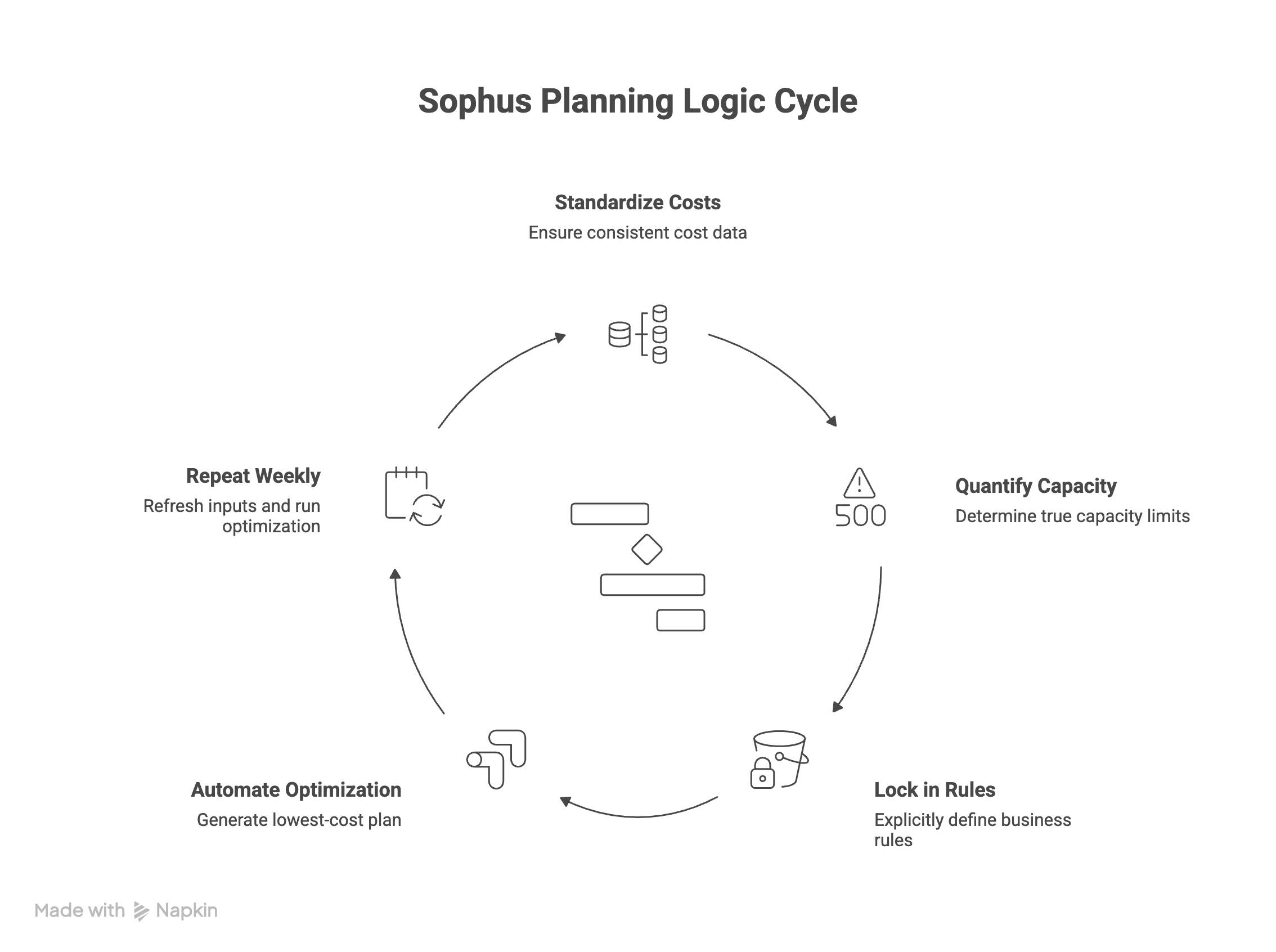
Step 1: Standardize Costs
All cost components were categorized and normalized. Labor, energy, transportation, and tax rates were refreshed regularly to ensure accuracy.
This eliminated inconsistent assumptions and provided a stable foundation for optimization.
Step 2: Quantify Real Production Capacity
Different products consume line capacity at different rates.
Sophus built capacity consumption coefficients for each product-line combination based on actual efficiency data, giving planners clear visibility into true weekly capacity limits.
Step 3: Capture all the essential business Rules
All business and operational rules were captured explicitly, including:
- Product–line mapping
- Seasonal production restrictions
- Regional allocation rules
- Taxes and logistics constraints
- Fulfillment priority rules
This prevented accidental rule violations and brought consistency to planning decisions.
Step 4: Automated Optimization
The optimization engine evaluated millions of feasible production and shipment combinations and generated:
- The minimum-cost plan
- That meets demand
- And satisfies every operational constraint
Instead of manually constructing a plan, planners now reviewed a system-generated plan that was already optimized.
Step 5: A Scalable Weekly Workflow
Planners only needed to refresh inputs, run the optimization, and review outputs.
The weekly planning cycle went from multi-day manual work to a standardized process completed in minutes/hours.
Clear, Measurable, and Significant Business Benefits
The transformation delivered immediate and substantial improvements:
Production Line Utilization Improved by 20%Sophus revealed unused capacity and rebalanced production across factories. Monthly Supply Chain Costs Decreased by Over $30 MillionOptimized sourcing, better factory allocation, and more efficient transportation reduced structural costs. Weekly Planning Time Shrunk from Days to MinutesAutomation replaced manual spreadsheet work and reduced planning variability. Productivity Increased Across Planning TeamsPlanners shifted from data manipulation to analyzing insights and executing strategy. |
The planning process became predictable, repeatable, and aligned with company targets.
What This Transformation Shows About Modern Supply Network Planning
Large-scale networks cannot be run on intuition or legacy workflows. As operations grow:
- Constraints multiply
- Costs interact in complex ways
- Manual planning introduces inconsistency
- Spreadsheets become unreliable
- Decision logic becomes fragmented across different teams
This case demonstrates a core principle of modern supply network planning:
- Standardization and optimization are essential infrastructure
- The manufacturer’s shift to an automated, data-driven weekly planning engine marks a decisive step forward in planning maturity.
- It replaced guesswork with structure, manual adjustments with optimization, and inconsistent planning cycles with a reliable weekly decision process.