


If you’ve ever wondered how a restaurant gets its fresh produce on time, or how your local grocery always has that same bottle of wine in stock, it’s because of companies like this one.
This food distributor runs an extensive network in the country, serving thousands of restaurants, hotels, and retailers every single day. For years, the company grew through scaling more warehouses, more products, and more regional coverage.
That strategy worked well in the early years. But over time, “more of everything” turned into “too much of some things, not enough of others.” Shelves filled unevenly, costs climbed quietly,
The Challenge: When One-Size-Fits-All Doesn’t Fit Anyone
The company’s core issue came down to a simple rule: every warehouse stocked nearly every product, all with roughly targeted 30 days of inventory.
That approach looked fair and consistent on paper. But in reality, it overlooked a key truth; different products source, move, sell, and replenish very differently across regions and seasons, each with its own lead times and supply requirements.
- Some products fly off the shelves in one region but barely move in another.
- Some are highly seasonal, while others maintain steady year-round demand.
- Certain items take 45 days to replenish from suppliers, while others can be restocked overnight.
- There are premium wines and imported ingredients products that are exceptionally sensitive to both timing and value.
This “everything, everywhere” approach led to three big problems:
- Inventory Imbalances – Some warehouses overflowed while others ran dry. The result: stockouts in one region and overstock in another.
- Costly Transfers – To fix shortages, the company constantly shipped goods between warehouses, driving up transportation costs and operational chaos.
- Inventory Write-Downs – High-value or slow-moving items like Premium wines and champagnes missed their peak sales windows, leading to markdowns and wasted capital.
The leadership team knew that the inventory allocation needed rethinking, but not through gut feel or guesswork. They needed clear, data-driven answers.
That’s when Sophus, the AI-powered supply chain decision intelligence, can help to map out what was really happening and find a smarter way forward.
Step 1: Building a Digital Twin
The first step was to create a digital twin of the company’s entire network and inventory allocation. It’s a virtual model that mirrors every warehouse, product category, supply and customer flow, inventory allocation.
This allowed the team to understand how costs, service levels, and inventory performance correlates at the current network and inventory settings.
The analysis quickly revealed what intuition had hinted at for years:
- All 12 distribution centers carried almost the same full range of products, even when local demand didn’t justify it.
- Most customers were served out of one DC.
- The cost structure across categories was wildly different, for some products, transport cost dominated; for others, the risk of inventory depreciation was the real deal.
Step 2: Redesigning the Inventory allocation throughout the network, Product by Product
With that insight, the team ran a series of supply chain optimization models to redesign the inventory allocation and product ranging.
Each product family was analyzed based on its sales pattern, seasonality, and cost structure:
- Fast-moving daily goods (like packaged foods and beverages) were best served through decentralized placement across multiple DCs. This reduced last-mile delivery costs and improved availability.
- High-value or short-shelf-life products (like premium wines or perishable items) were better suited to centralized locations, minimizing inventory depreciation and waste.
- Seasonal items were mapped to regions with matching demand cycles, reducing both overstock and missed sales opportunities.
- The model also recommended new replenishment frequencies and policies — how often each product should move, and from which DC — balancing cost and freshness dynamically instead of uniformly.
Step 3: Building a Decision Framework for the Long Run
Sophus didn’t just hand over a report. It helped the company set up a repeatable decision framework so the optimization could continue week after week.
This framework connected directly to the company’s data sources, refreshing the model automatically as sales, demand, and cost data changed. Planners could now:
- Update stocking plans,
- Simulate what-if scenarios (e.g., “What if we add a new customer to the network?” or “What if we take out a product line?”),
- And make inventory decisions with full visibility across the network.
What used to take months of spreadsheets and meetings became a living, data-driven process that could adapt to market changes in near real time.
The Benefits
After implementing the optimized network, the results spoke for themselves:
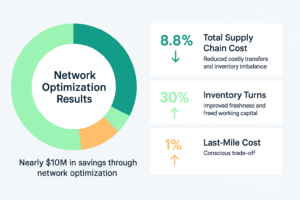
- 8.8% reduction in total supply chain cost. Most of the savings came from eliminating costly transfers between DCs and reducing inventory imbalances.
- 30% improvement in inventory turns, improving freshness and freeing up working capital.
- Slight (1%) increase in last-mile distribution cost, a conscious trade-off
In total, the initiative unlocked nearly 10 millions of dollars in savings, while maintaining service reliability and product freshness at the same time.
The Bigger Picture
Many distributors and retailers face similar hidden inefficiency: networks and inventory strategies built on legacy habits and cross-department compromises, rather than on data-driven intelligence and optimal design. The takeaway is clear: true optimization isn’t about trimming costs at the edges; it’s about rethinking the logic at the core.
With Sophus, this food distributor finally struck the right balance between centralization and flexibility, cost and freshness, simplicity and intelligence.