

According to Gartner, network design is the optimization of the function and location of supply, distribution, and manufacturing networks in support of customer requirements and an overarching company strategy. Supply chain network design software supports the creation of network models with the application of analytics to identify the best supply chain design in a scalable, structured, and repeatable way.
These tools support the determination of recommendations about the supply chain network structure. It includes decisions about facility size and locations, modes, and transport lanes in the end-to-end supply chain. The scale of the changes being evaluated varies from small modifications, such as changing a mode of transport or swapping transportation lanes, to large-scale changes that involve opening/closing/repurposing several facilities in the network and the associated knock-on impacts.
Unlike what a manual process allows, the use of supply chain network design software to support the decision-making procedure allows companies to review more potential network configurations, supporting a complete, data-driven decision-making process. These decisions are mostly made in tactical and strategic time frames.
To help you with the same, this article lists the top 5 supply chain network design software.
Why Modern Supply Chain Design Software Matters in 2026
Traditional supply chain design approaches can no longer keep pace with today’s volatile market conditions. Legacy desktop-bound solutions create collaboration bottlenecks, while limited processing power prevents organizations from running the hundreds of scenarios needed for comprehensive risk assessment. Modern supply chain design software addresses these challenges through:
- AI-powered automation – Natural language interfaces and intelligent scenario planning reduce modeling complexity.
- Cloud-native architecture – Advanced model sharing and parallel processing across distributed teams.
- Integrated risk assessment – Automatic risk scoring that considers geopolitical, environmental, and operational factors.
- Discrete event simulation – Test network designs with advanced variability before implementation.
|
Tool |
Data integration & transformation |
Scenario / What-if capability |
Algorithms in AI, Optimization, andSimulation |
Visualization & stakeholder alignment |
Ease of use (Business-friendly vs Specialist) |
Budget / TCO fit |
|
Sophus X |
Highly efficient and automated data integration and transformation through its embedded ETL – ‘’Dastro‘ Support connection and integration with Datalake, ERP or any other type of data sources. |
Strong — fast what-if scenario planning (open/close DC or production line, Lead time change, demand spikes) |
Strong AI, Optimization and limited simulation. AI driven demand forecast, AI enabled solver, Optimization on end to end supply chain Simulation on inventory, production |
Interactive maps, dashboards, fast scenario comparison, integrated custom BI |
Very business-friendly — minimal modelling expertise needed, No coding is needed |
Best value; suitable for mid-market and large enterprises |
|
Coupa Supply Chain Design |
Good Data integration through its ETL – DataGuru, Though DataGuru is limited to desktop version |
Strong scenario planning, multi-variable what-if |
Strong Optimization and + limited simulation Optimization on end to end supply chain Simulation on inventory, production |
Good visual reporting, map comparisons across scenarios Limited BI dashboard |
Moderate — easier for enterprise users, not ideal for beginners |
High cost; enterprise pricing |
|
AIMMS SC Navigator |
No ETL is embedded, Excel or database driven data integration, |
Strong what-if scenario modeling capacity, but require certain level of coding (not easy to use) |
Strong Optimization and simulation but difficult to use |
Good visual reporting and map integration,but certain part of UI requires coding |
To solve simple problems can be easy to use, when getting to a point to model details, can be really hard to use(require coding and Operational research background) |
Medium to High cost; suited for larger organizations |
|
Optilogic Cosmic Frog |
No ETL is embedded, Excel or database driven data integration |
Strong scenario modeling capability but require certain level of coding (not easy to use) |
Optimization and certain level of simulation |
Clean dashboards; intuitive visuals for stakeholders |
Moderate — in general easy to use but require certain level of coding and Operational research background |
High cost; enterprise pricing |
|
anyLogistix |
No ETL is embedded, Excel or database driven data integration |
Limited and hard to use — require certain level of coding |
Strong Simulation- limited supply chain optimization capability |
Good visual reporting and map integration strong visualization for animation of flows |
Difficult to use — require advanced coding and operational research background |
Mid-range; learning edition available |
Go through it to grab the details of each tool, decide, and get started with the best tool at the earliest.
Sophus X
Sophus X represents the next generation of supply chain network design software, built from the ground up with modern cloud-native architecture and embedded AI. Unlike traditional tools that require extensive technical expertise, Sophus X makes advanced optimization accessible to business users while maintaining enterprise-grade performance.
Core Capabilities
- Embedded AI & Automation: AI-enabled demand forecasting and solver optimization eliminate manual modeling complexity.
- Real-time Data Integration:Fully embedded ETL (‘Dastro’) connects seamlessly with data lakes, ERPs, and external sources.
- Advanced Scenario Modeling: Fast what-if analysis for facility changes, lead time adjustments, and demand spikes.
- Risk-Aware Optimization: Multi-factor optimization considering cost, service, sustainability, and resilience.

Sophus X Advanced Features
- Custom BI Generation within the tool
- Fully embedded ETL integration ETL Data Processing
- Rapid baselining – build a model of ‘As-Is’ in days not weeks
- Model carbon costs through a supply chain
- Identify the best locations for facilities based on multiple factors by using the Greenfield site selection feature
- Design the optimal network to distribute spare parts by leveraging the aftermarket spare parts network design model
- Plan the distribution network structure to reduce costs and improve efficiency
- Let the supply chains of merged or acquired entities fit together by using the Mergers & Acquisitions (M&A)
- Design supply chains that integrate various sales channels smoothly through the Omni-Channel Supply Chain Network Design feature
- Optimize the inventory level across your supply chain network through an inventory optimization solution
- Plan detailed transportation routes once you fix your supply chain network
- Develop a model for triggering product replenishment at the DCs based on predefined minimum/maximum Days of Supply (DOS) levels
- Private cloud deployment

Know more about Sophus X in this video:
Why Sophus X is the Perfect Software for Supply Chain Network Design?
- Speed: SophusX runs up to 20 times faster than similar competing solutions. This would truly save a great deal of time for the company as well as the users of the software
- Easy to use: The user interface of SophusX has been designed with the goal for the most intuitive to use, and for Supply Chain Design professionals it would take minimal effort to get hands-on with the tool.
- Efficiency: Apart from faster speed, Sophus has been designed to improve the user’s efficiency by 3X, and 4X, by adding features such as rapid baseline, automatic data validation, free of infeasibility diagnosis,
- And many more. For a user, saves a great deal of time so users can spend their time on more valuable things. For a company, this means unlocking more business benefits and returns.
Coupa
Using first-generation technologies, and supporting ETL data processing, Coupa helps companies in their supply chain network design and planning, However, Coupa’s technology update has been slow and its algorithm architecture was still based on a structure that was developed more than 15 years ago. Moreover, it has become an unaffordable choice for businesses with a tighter budget.
AIMMS
AIMMS comes out to be a great supply chain modeling tool for businesses looking for a highly personalized supply chain network design. Its low code platform allows the non-tech-savvy team to work on it efficiently. Moreover, the SC Navigator gives you an opportunity to visualize and test different supply chain scenarios.
Although the platform is a low code platform but still requires coding to achieve lots of features and functions, it has a higher entry barrier for the users. Furthermore, its pricing structure is almost similar to Coupa’s, making it another expensive option for businesses.
Optilogic
Optilogic is a cloud-based supply chain network design tool. It prioritizes flexibility, scalability, and ease of use. However, Python’s performance in terms of speed and memory usage is generally lower. Make sure you fully test the performance if you have large and complex models.
AnyLogistics
Anylogistics is highly regarded for its strong capabilities in supply chain network design. It excels in modeling complex logistics networks, optimizing transportation routes, and simulating diverse scenarios to enhance efficiency and cost-effectiveness.
However, its user interface is often criticized for being challenging to navigate, designed more for technical users than general ease of use. This complexity can require additional training or support for non-technical personnel to fully leverage its powerful analytical tools.
Aspects That You Should Consider While Opting for a SCN Design Software
You should consider the data integration and modeling capabilities, performance of the optimization algorithms, scenario analysis capabilities, data security, user interface, support, and visualization and reporting capabilities of a supply chain modeling software while opting for one.
Here’s a list of factors you should consider before choosing a supply chain network design software:
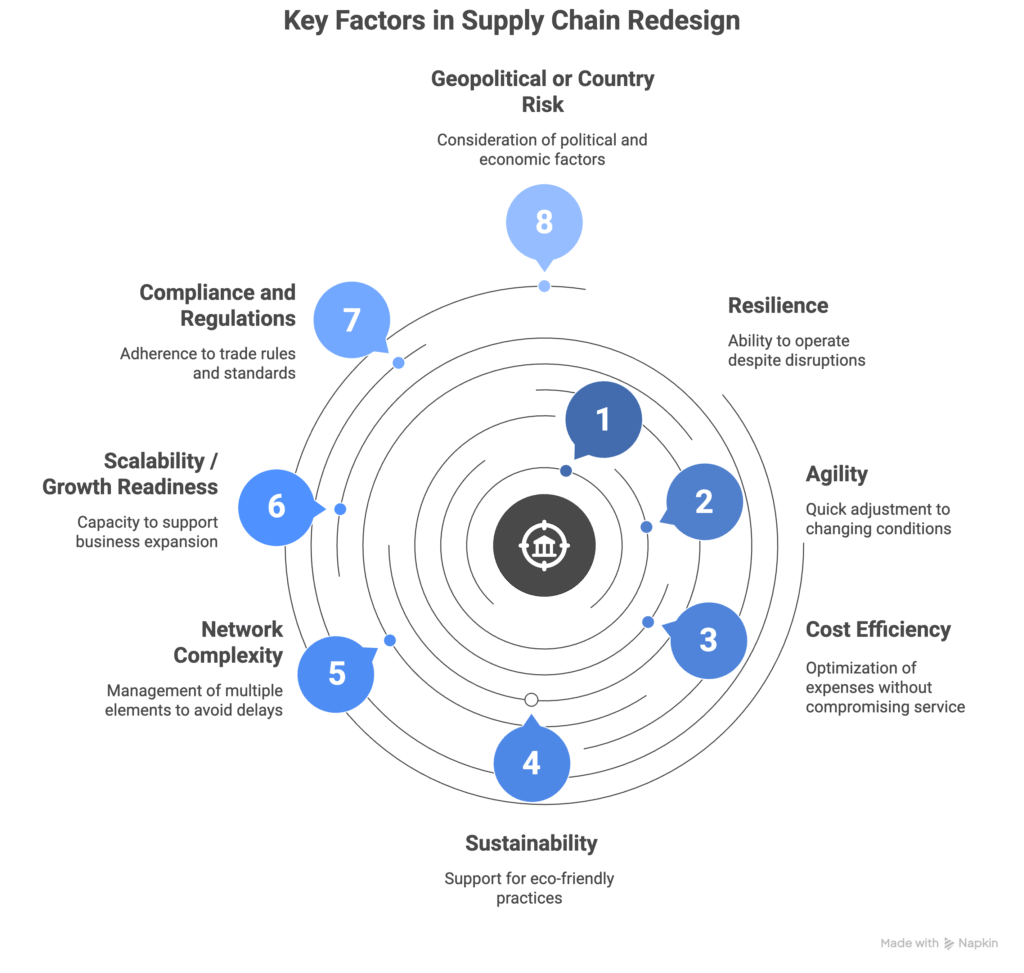
Resilience:
Can your network continue operating if a supplier, route, or region becomes unavailable?
Agility:
Can you adjust quickly when demand shifts, customer preferences change, or forecasts are wrong?
Cost Efficiency:
Are storage, transportation, and handling costs higher than they should be? Can costs be reduced without hurting service levels?
Sustainability:
Does the current network support emissions reduction, cleaner transport modes, and eco-friendly sourcing?
Network Complexity:
Are too many suppliers, warehouses, or manual steps creating delays or confusion?
Scalability / Growth Readiness:
Will the existing network support new products, new markets, or business expansion?
Compliance and Regulations:
Are new trade rules, certifications, or industry standards forcing changes in sourcing or distribution?
Geopolitical or Country Risk:
Are political instability, currency fluctuations, tariffs, or trade restrictions affecting supply performance?
Go for the software that fits, if not all, at least most of the above-stated criteria.
Getting Started with Modern Supply Chain Design
Choosing the right supply chain network design software significantly impacts your organization’s ability to respond to market changes, optimize costs, and build resilient operations. Based on our analysis, here are key recommendations by organization type:
For Mid-Market Companies
Sophus X provides the optimal balance of advanced capabilities and business-friendly design, offering enterprise-grade optimization without the complexity or cost barriers of traditional tools.
For Enterprise Organizations
Consider your integration requirements and technical resources. While other tools offer robust capabilities, they also require significant technical expertise and higher total cost of ownership. Sophus X, on the other hand, is designed for fast deployment, low maintenance, and ease of use, making it ideal for teams that want powerful optimization without complex setup or heavy IT support.
Next Steps
Ready to transform your supply chain network design process? Request a Sophus X demo to see how modern, AI-powered network optimization can accelerate your decision-making and deliver measurable results.
Key takeaway: The most successful supply chain transformations combine advanced optimization capabilities with practical, business-friendly implementation – exactly what Sophus X delivers.